Boosting farmer income: Water Conservation Technology for Irrigation in Agriculture
AgroTrace is a state-of-the-art IoT-enabled smart solution designed to optimize irrigation and fertigation management in agriculture. By using advanced sensors, proprietary AI algorithms, and IoT connectivity, AgroTrace ensures efficient use of water and nutrients, helping farmers reduce wastage and improve crop yield.
Device Overview and usage
Purpose: Efficient irrigation and fertigation management system
Key Features: –
- Measurement of Soil Water Potential and Temperature at multiple depths.
- Estimation of real-time water requirements in the soil.
- Optimized irrigation scheduling to avoid water and nutrient leaching.
- IoT-based data transmission through LTE network for seamless connectivity.
- Real-time analysis using proprietary AI algorithms. – Accessible on mobile platforms (iOS & Android).
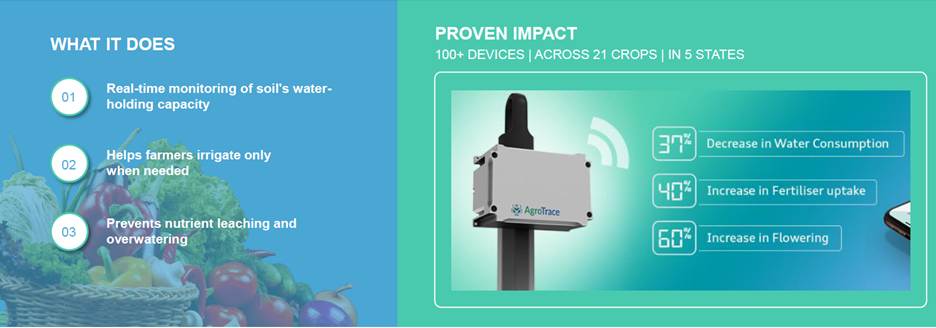
AgroTrace operates by measuring Soil Water Potential (SWP), a key parameter in irrigation management. SWP provides information on the amount of water held within the soil and helps determine the right amount of irrigation, preventing over-watering and nutrient leaching. It monitors the following:
- Soil Water Potential: Measures the force required by plant roots to extract water from the soil. Ideal for avoiding over-irrigation.
- Field Capacity: The point at which soil water potential is 0.3 centibar (cb), beyond which leaching occurs.
- Efficient Root Zone: The depth at which the majority of water and nutrients are absorbed by roots. The depth varies with the stage of the crop (Vegetative, Flowering, Fruiting).
By understanding these critical points, AgroTrace optimizes irrigation scheduling according to the crop growth stage and soil type. Data from the soil moisture and temperature sensors is sent to a central database. The data is then analyzed using proprietary AI algorithms, and the results are pushed to the AgroTrace mobile application in real time.
Demonstration of effectiveness of the technology
An experiment on watermelon and chickpea crops was done to evaluate AgroTrace’s effectiveness. The following data points were measured for the watermelon crop:
| Parameter | Without AgroTrace | With AgroTrace | Remarks |
| Time to flowering stage (days) | 63 | 55 | This signifies increase in fertiliser uptake |
| Average No. of flowers per plant | 35 | 56 | This shows the increase in the flowering rate per plant |
| No. of deep irrigations (more than 1 hour) throughout the crop cycle | 13 | 8 | This shows decrease in water consumption |
The data indicated that using AgroTrace led to: –
- A reduction in time to flowering stage by 5 days.
- An increase in the average number of flowers per plant by 21.
- A decrease in the number of deep irrigations required by 5.
Study On Nutrient Leaching
The graph shows the study of nutrient leaching patterns in the watermelon farm with sandy soil. This type of soil is highly prone to nutrient leaching and hence very difficult to manage stress.
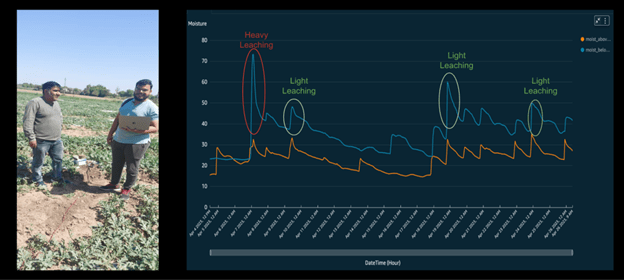
First Irrigation
In the first irrigation, the farmer applied water through his will, and 60% of the water with the nutrients was leached by the morning. After explaining this to the farmer, he understood the problem and started using our recommendation. Since then, we have regulated the water supply and amount of stress.
Second Irrigation
This cycle was to give the necessary nutrients required for the flowering stage. As heavy irrigation was given the previous day, we tuned the water supply to minimize leaching.
Third Irrigation
This is the most important part. We observed a gap of 3-4 days between the 2nd and 3rd irrigation. This is called the application of water stress, where we stopped the supply of water. This stress induced faster flowering rates in the plants.
In the subsequent irrigation cycles (used for fungicides), we tuned the duration of irrigation to optimize nutrient leaching.
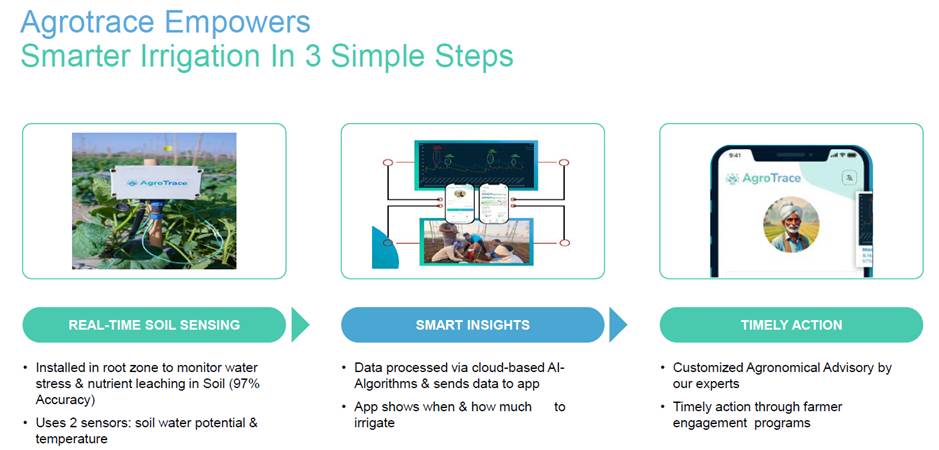
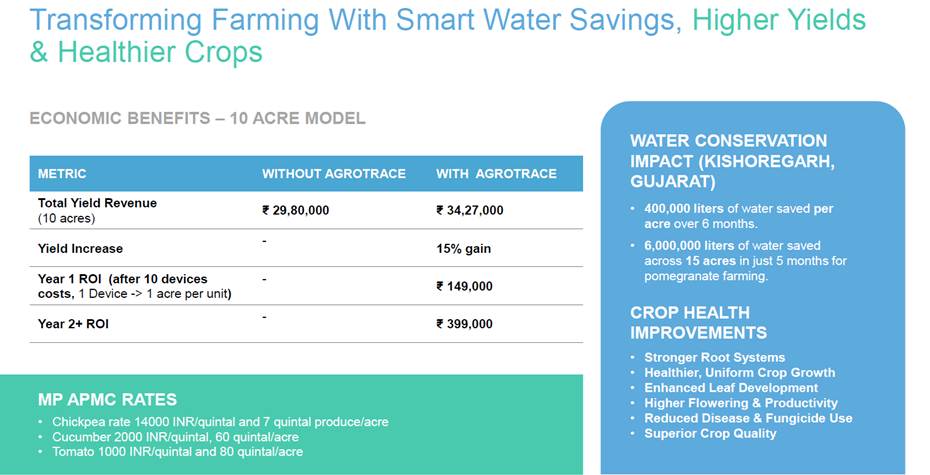
AgroTrace has proven to be an effective tool for efficient water stress management in horticultural plants. By accurately measuring soil water potential and optimizing irrigation schedules, it enhances fertilizer uptake, reduces water usage, and promotes faster flowering. The experiment demonstrates significant improvements in watermelon crop performance, indicating AgroTrace’s potential to revolutionize irrigation practices in agriculture.
AgroTrace represents a significant step forward in precision agriculture, offering farmers a smart, data-driven approach to managing water and fertilizer use. With its advanced sensors, IoT connectivity, and AI-driven insights, AgroTrace is designed to maximize agricultural productivity while minimizing resource wastage.
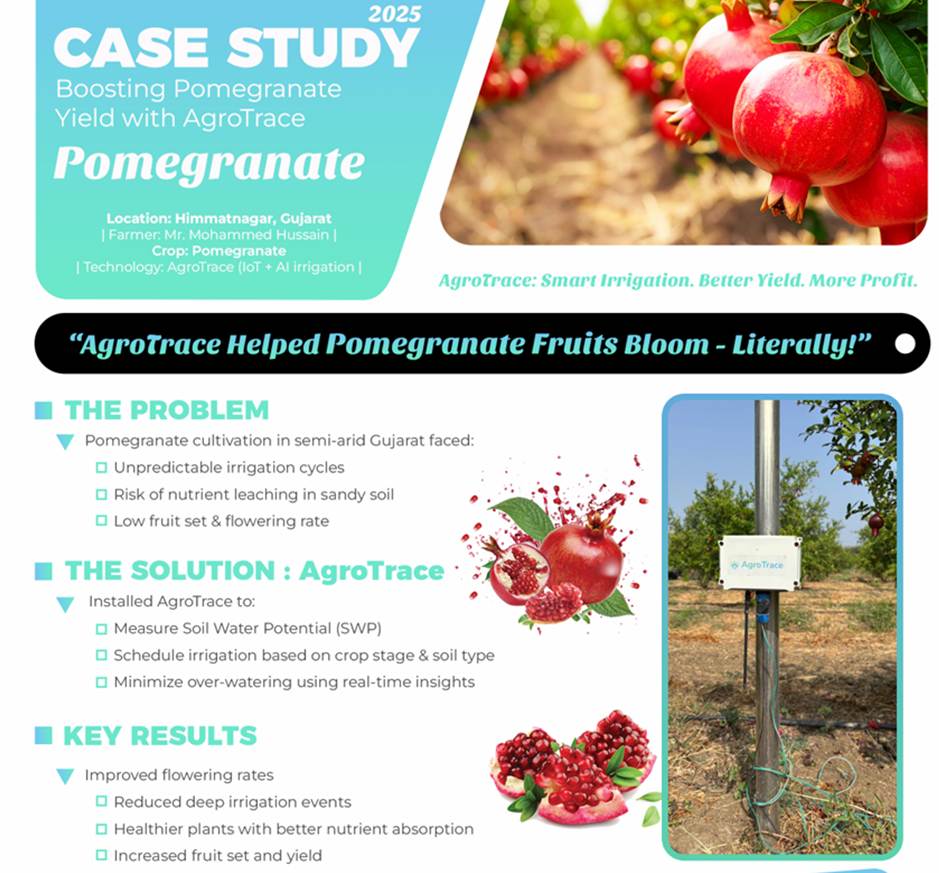
Case Study: Pomegranate
 Center for Social Integration and Borderless World